

Catastrophizing Doesn't Predict the Future. It Replaces the Present.
Rehearsing disaster so you don't have to sit in the not-knowing
Quick favor: tap the little the heart 🤍 at the bottom of the post. It helps this reach more people and keeps me from pretending I don’t care about the algorithm.
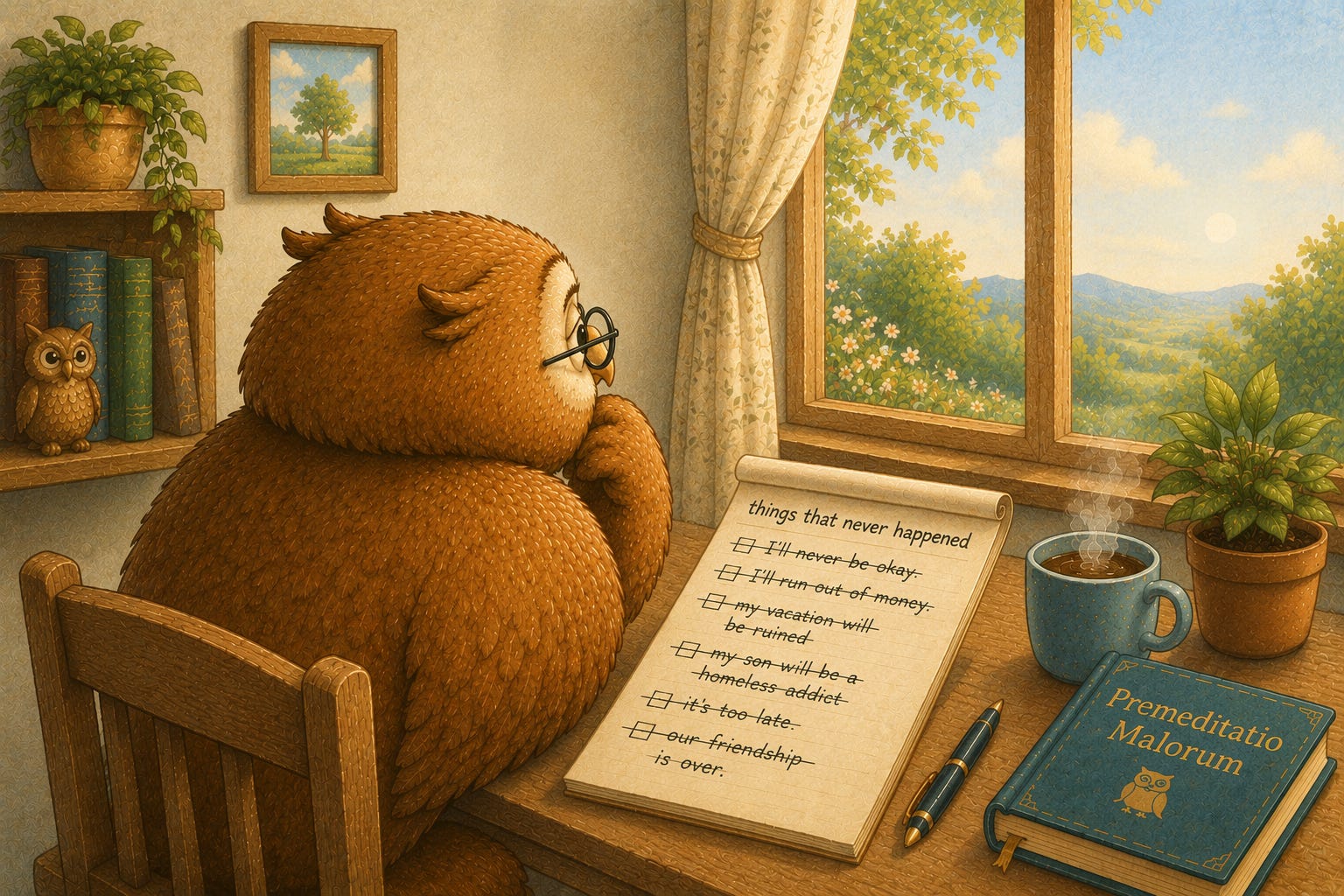
I have a list of things I was certain were about to go wrong.
The ultrasound that was going to flag the need for a biopsy because the small mass had to be cancer. The text that didn’t get answered fast enough, which meant the friendship was obviously over. The flight delay that was going to cascade into a missed connection, a missed event, and a ruined trip. The silence after I sent that email, which could only mean I’d finally said the wrong thing to the wrong person.
None of it happened.
The ultrasound showed no signs of cancer so there was no need for a biopsy. Unanswered texts are rarely the end. And flight delays are so common now that I just buy travel insurance in case something happens I can’t do anything about.
Speaking of flight delays, I lost my driver’s license at the airport when my kids and I were coming home from Alaska. I sat down on the airport floor and cried, because in my head I had stranded all of us two thousand miles from home with no way to prove I was who I said I was. I checked my pockets and my purse umpteen times and my license was nowhere to be found. I thought we were screwed.
What actually happened is I have TSA precheck and Delta Skymiles, so my information was already in the system. I also already had my boarding pass. It really only took a few extra minutes of confirming my identity through my other credit cards and store cards. Oh and my AARP card. Thank you AARP! The only real delay was that they went through every single item in my luggage by hand instead of waving me through precheck.
We made the flight. I got home at the same time I was supposed to.
I have decades of experience rehearsing disaster, and disaster has missed almost every appointment I scheduled for it.
If you do this too, I’m not going to tell you to stop.
I’m going to tell you why you can’t, and why that’s not the same as something being wrong with you.
What I Couldn't See Coming
The certainty catastrophizing seems to offer isn’t actually certainty about the future. It’s relief from the discomfort of not knowing right now. Those are different things, and the second one is the one you’re really after.
In order to stop sitting in the in-between, you catastrophize a fake ending so the not-knowing has somewhere to go.
I learned this the hard way with my older son. His father died when he was ten, and somewhere in the years that followed his grief turned into full-blown addiction. The addiction didn’t look like grief from the outside though, it just looked like a kid making some really bad choices.
He went through inpatient programs, outpatient programs, therapy, probation, and random drug testing. He still got expelled from school. He still ended up in juvenile detention.
While I was going through these tortuous years, I had already written the story of how this was going to turn out. Nothing I did or said or provided was changing his behavior so obviously he’d be a homeless addict or incarcerated by thirty, if he made it to thirty. He would cut all ties from me because he’d blame me for making his life a living hell. I grieved a future that hadn’t happened yet, in real time, while the actual present was still unfolding in front of me.
Fast forward a few years. He’s an entrepreneur now. He has the street smarts only a kid with his background could have and it’s proved to be beneficial in running his own business. He’s the kind of young man other people describe as solid, dependable, an all around stand-up guy. Oh, and he calls his mother with every bit of news, good or bad.
The version of him I rehearsed for years — the one I was so sure was coming — never showed up. The version that did show up, I didn’t see coming at all.
You Have a Bad Strategy, Not a Broken Brain
Catastrophizing isn’t a flaw in your thinking. It’s a strategy (albeit a bad one). The strategy is where your mind runs every possible ending so that whatever actually happens, you’ve already seen it coming.
It’s exhausting and it’s also, in a strange way, logical. If you can predict the disaster, you can prepare for it. If you can prepare for it, you’re not as helpless as uncertainty makes you feel.
The problem isn’t that you’re imagining bad outcomes. It’s that you’re mistaking the rehearsal for protection from those bad outcomes. You didn’t survive the biopsy because you imagined it a hundred times in the shower. You survived it because it wasn’t cancer. The imagining didn’t do anything except cost you several mornings of sanity.
The Stoics had a practice for this, and it’s not what most people assume Stoicism is about.
Premeditatio malorum — the premeditation of evils — is about naming what could go wrong, once, clearly, and then setting it down. Marcus Aurelius wasn’t lying awake running every bad scenario on a loop. He named the possibility — loss, failure, death — looked at it directly, and went back to the work in front of him.
The naming was the whole practice. Not the looping.
That distinction is the difference between what I was doing in that airport, and at my kitchen table during the worst years with my son, and what was actually meant to help. I wasn’t naming the fear once and setting it down. I was replaying it, refining it, and adding new scenes. That’s not premeditation. That’s a story I kept writing and rewriting because as long as I was writing it, I wasn’t waiting for an ending I didn’t control.
Taoism names the same trap a little differently. The instinct to grip tighter when you don’t know what’s coming is the opposite of what the tradition calls Wu Wei.
Wu Wei means not forcing what can’t be forced, including outcomes.
What they say is that water doesn’t fight the rock. It moves around it and finds the path that’s actually there instead of the path it wishes existed.
Catastrophizing is gripping a rock that hasn’t shown up yet.
Name it the Stoic Way
I didn't actually want to know my son would end up incarcerated for life. That was obviously not the life I imagined for him. But I desperately wanted to stop sitting in the not-knowing of what would happen to him. The catastrophizing gave the not-knowing somewhere to go.
Your mind is doing its best in a situation it’s not prepared for. The problem is that unfamiliar gets coded as a threat whether or not anything is actually threatening. Your spinning brain starts the rapid breathing and tightening in your chest and now your body starts pumping adrenaline because it’s preparing for the flight or fight response. All because you think you know how this ends.
Even though the in-between is uncomfortable because it’s unfamiliar, it isn’t dangerous the way your body thinks it is.
So what do you do with that, on an ordinary day, when the worst-case scenario starts writing itself again?
You don’t have to fight it off. Fighting it is just another form of gripping.
Instead, try naming it once, the Stoic way. You can either say it out loud or write it down on paper. It doesn’t matter how you do it as long as you name it.
“I’m afraid this is going to go badly.” Said plainly, once.
Then notice the urge to keep going, to add more detail, to rehearse the worst version a second time. The fear named itself in one sentence. Everything after that is the rehearsal talking, not the threat.
This won’t make discomfort of the not-knowing disappear. Nothing does that.
But the list you're keeping of everything that was supposedly about to go wrong keeps turning up empty.
When Control Was Never Yours to Begin With

Powerlessness is one of the most disconcerting feelings there is. It exposes something most of us have been avoiding: the fact that control was always more limited than we really wanted to believe.
If this hit a nerve, please consider restacking it. Or better yet, say something in the comments.